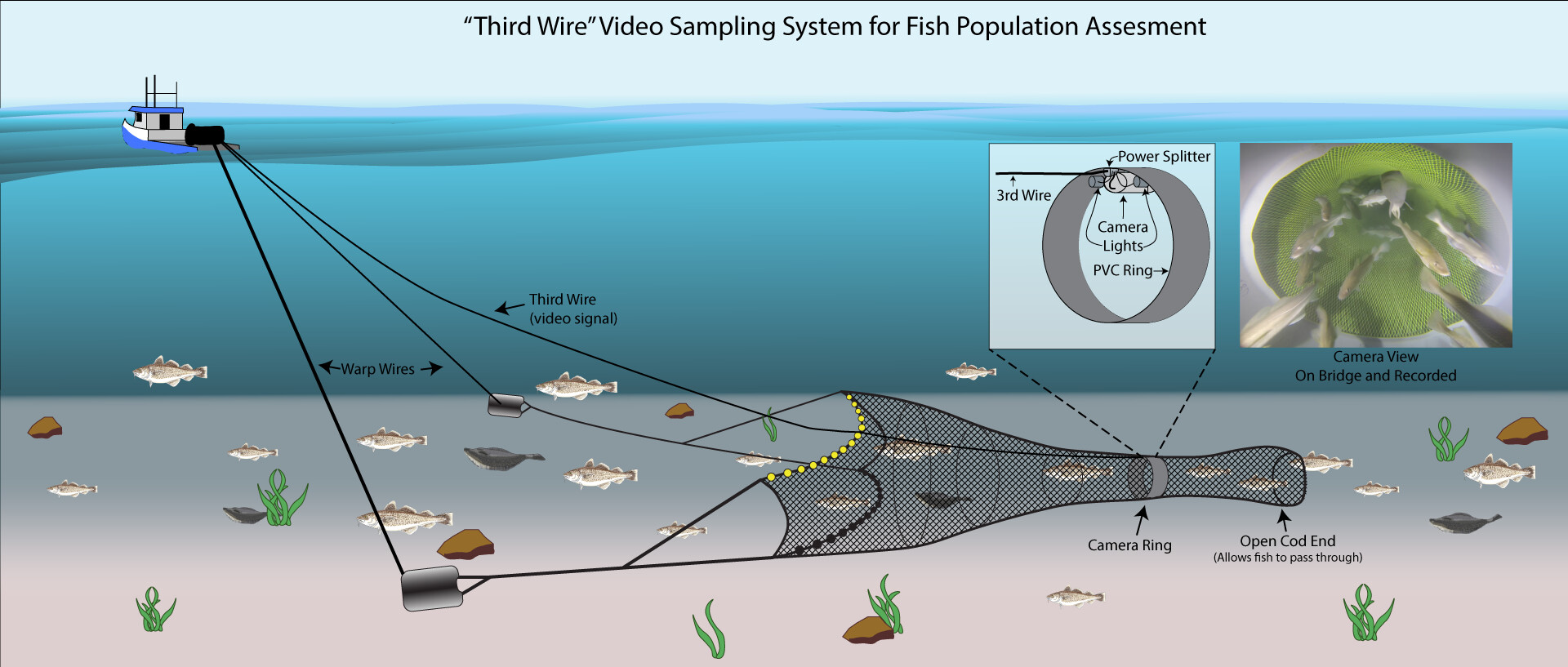
A diagram/cartoon created to help explain and show how the UMass Dartmouth open cod end video sampling system works.
A diagram/cartoon created to explain how the UMass Dartmouth open cod end video sampling system works and can be easily adopted by most fishery fleet boats across New England.
This system can be employed on most scallop and groundfish boats in the New England fishing fleet. We (well, UMassD-SMAST, which I was a postdoc for during the time this system was being developed at the lab) deployed it several times a year during development and testing on New Bedford-based scallop boats and groundfish draggers. It consists of a PVC ring that can be quickly sewn into a net between the belly section and the cod end. A power splitter, two underwater video lights, and an HD or higher resolution camera are mounted to the ring. The power and data needs are served through an electrical umbilical cable. Video from the camera is fed to the bridge, displayed live on the bridge monitor, and to a recording computer system. The recording computer injects the vessel's frame-by-frame GPS position (with an offset for the net cable paid out) into the video.
In use, the cod end is generally left open during scientific sampling, allowing the fish to exit the net into the open waters safely. Graduate and undergraduate students analyze videos from all tows to identify species, estimate size, and count fish numbers by species. This allows the identification of fish presence and density to a precise geographic point at a particular time. The lab is also working on the iterative process of training a machine-learning algorithm to identify the fish and calculate their size programmatically. When I left, it was an ongoing effort, but for most of the species of commercial interest, the algorithm was on the mark better than 70% of the time to the species level. Unfortunately, some of the fish groups that are commercially important pose issues at this time - flatfish (5 major species all very similar visually) and skates (4 species of which 2 are nearly identical visually), for instance.
An example (ok, biased choice, but still - for impact - all these fish escaped the other end of the net and... lived to grow and breed )
here is a tow from when I was with SMAST - can you identify and count all the fish? https://www.youtube.com/watch?v=cHLy9Wwbbxw&t=613s
When my post-doc concluded, I had developed the next-generation system plan using higher resolution 2k or 4k cameras and a smaller, self-contained computer appliance system for use in two configurations by science teams (with full feedback and keyboard) and for fishing boats to be able to use with minimal additional effort. The fishing vessel configuration replaces the keyboard as the primary interface with a single large button USB interface that the captain only needs to hit as he starts to drop the net at the beginning of a tow and after he has raised the net at the end of the tow. The higher resolution cameras would aid in species discrimination but, unfortunately, impact programmatic processing time by current machine language systems. Of course, the 2k or 4k video can be used by human analysts, and cropped or down-scaled video can be used to continue to train the computer algorithm. Unfortunately, due to the government shutdown, we did not have funding available at that time to realize that project upgrade. Hopefully soon.